

A Ceiling Set in 1993
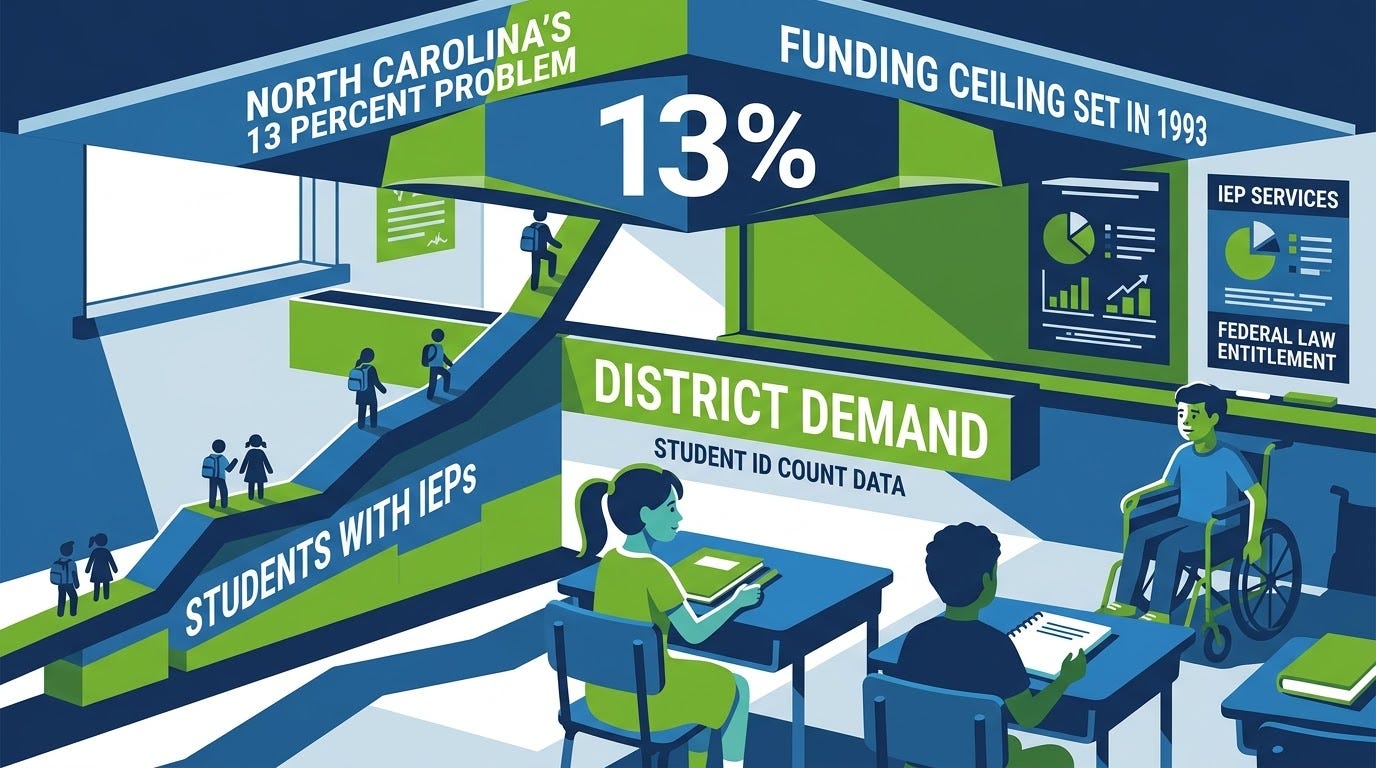
North Carolina pays school districts for special education students up to a point. That point is 13 percent of a district’s average daily membership. A district can identify a thousand students who need services under an Individualized Education Program. If that number exceeds 13 percent of enrollment, the state funds the district as if the extra students were not there.
The law behind this, G.S. 115C-111.05, dates to 1993. The original cap was 12.5 percent. Lawmakers raised it to 13 percent sometime after, and it has held there since, while the population it measures kept moving.
I left Wilson County Schools 10 years ago. The cap was a minor consideration then because it hadn’t yet become a problem. Much has changed in the intervening decade, both in North Carolina and across the country. Wilson is one of the 12 districts still below the 13% cap, but I can’t speak to the work current leaders there have done in the intervening years to make that a reality.
Nine Districts in Ten
I built the North Carolina Special Education Stress Index this year using December child count data from the Department of Public Instruction, matched against enrollment from the same collection periods. The trend line tells the story plainly. In December 2019, 13.24 percent of students in North Carolina’s 115 traditional school districts were identified for special education, and only 30 of those districts stayed under the 13 percent cap that year. By December 2025, that figure reached 14.66 percent, and just 12 districts remained under it. In six years, the number of districts over the cap grew from 85 to 103, nearly three in four to nine in ten.
The mechanism behind the cap is easy to picture in numbers. North Carolina pays a flat rate per funded student, close to $5,300 in the 2023-24 school year, the most recent figure available in this research. A district serving exactly 13 percent of its enrollment collects that full rate for every student. A district serving 16 percent, no longer an unusual figure anywhere in the state, collects the same total dollars spread across a larger group. The effective rate per student falls, even though the number printed in the statute never moves.
Federal law does not adjust for any of this. It entitles every student with an IEP to the services that plan specifies, regardless of where a district’s enrollment falls relative to a state funding formula. The gap between what the state pays for and what districts must deliver gets filled from somewhere else. Usually that means general fund dollars or fund balance that would otherwise support classroom instruction, staff pay, or facilities.
Two Attempts to Fix It
State officials have known about this gap for years and have tried to address it twice. Neither attempt has become law. The Department of Public Instruction began developing a different funding model in 2021, after the General Assembly directed a formal study into paying for special education based on the actual cost of services delivered rather than a fixed percentage of enrollment. DPI presented the resulting weighted funding model to the legislature in early 2024. The model would eliminate the 13 percent cap and fund districts according to the intensity of services their students need. Neither party’s leadership in the General Assembly has adopted it in the past two years.
A second, narrower attempt is currently sitting in the Senate. Senate Bill 960, filed in the spring of 2026, would raise the cap from 13 percent to 16 percent. It would not eliminate the percentage-based structure entirely. It would also create a separate High-Cost Disabilities Support Fund for districts serving students whose costs exceed a threshold the State Board of Education would set. The bill proposes roughly $98 million combined for the higher cap and the new fund. The Senate referred it to the Rules Committee in early May 2026, and it has not moved since.
Who’s Left Picking Up the Tab
Both proposals diagnose the same problem from different angles. One would replace the percentage entirely. The other would raise it by three points. Neither has passed. Whichever approach eventually becomes law, if either does, will not undo the years districts have already spent absorbing this gap out of budgets built for other purposes.
While some legislative relief would be welcome, neither proposal solves the deeper problem. The $5,300 per-student rate doesn’t come close to covering the actual cost of serving a student with a disability. Districts already draw on funds that are just as urgently needed elsewhere to cover what that rate doesn’t touch: costs like over-identification, assistive technology, out-of-district placements, teacher turnover, and lawsuits.
None of that legislative history helps a district finance officer closing out this year’s budget. The formula still measures 2026 enrollment against a ceiling the General Assembly set in 1993 and adjusted only once since. Every point above that ceiling is a bill someone in the district must find a way to pay.
Dr. Sean Bulson is a practitioner-scholar, professor of educational leadership, and the 2024 Maryland Superintendent of the Year. He served as superintendent of Harford County Public Schools from 2018 to 2026 and Wilson County Schools from 2011 to 2016.