The Org Chart Points the Wrong Way
An accountability office that serves the state isn’t the same as one that serves schools. North Star taught me the difference the hard way.

Our accountability team sat inside the Office of Curriculum, Instruction, and Assessment, an office everyone called CIA. The team was proud of their acronym. In the division title, the "A" stood for Assessment, but the team within CIA was the Office of Accountability. Nobody had planned that confusion. It just told you something about how the office had evolved. It existed to manage state assessments and produce the accountability reports the state required. Somewhere along the way, everyone had started assuming that meant it also owned the district’s data strategy for schools, but it didn’t.
Central office exists to support schools. That’s the argument I make in Lesson 2 of the New Superintendent Field Guide, and it’s an easy sentence to agree with. Data is where I’ve found it actually gets tested.
An accountability office that spends most of its energy producing compliance reports for the state is managing up rather than helping schools function better. I’m not minimizing that work. State reporting is real, often onerous, and it has to happen somewhere. Keeping that burden off schools is a legitimate reason for the office's existence. But it isn’t the same job as putting useful information in front of a principal before a small problem becomes a large one, and treating the two as interchangeable is how a district ends up with a data office that has never actually served a school.
The arrangement we had was absurd once I saw it plainly. We required every school to build its own data tools, spreadsheets, trackers, whatever a resourceful assistant principal could cobble together, because the central office wasn’t providing anything usable. Meanwhile, that same central office was collecting enormous amounts of data from those schools, refining it, and sending it up to Annapolis. The data moved up constantly. It rarely moved back down in a form anyone in a school could use.
I saw the gap most clearly in year two of my superintendency, around the time of our first major academic initiative. We called it North Star. Every student was expected to leave high school having done one of three things: earned an external career credential, completed a college course for credit, or succeeded in an AP, IB, or CTE pathway course that carried transcriptable credit. The goal was simple to state and hard to track. Even inside a single school, knowing which students had met the requirement, which were on track, and which weren’t takes real infrastructure.
We launched North Star without that infrastructure. Some schools built their own monitoring tools and managed. Others had no way to see which students were falling behind until it was too late to intervene. The variance between schools had nothing to do with how much anyone cared about the initiative. It came down to which schools happened to have someone who could build a spreadsheet good enough to compensate for what the district hadn’t given them.
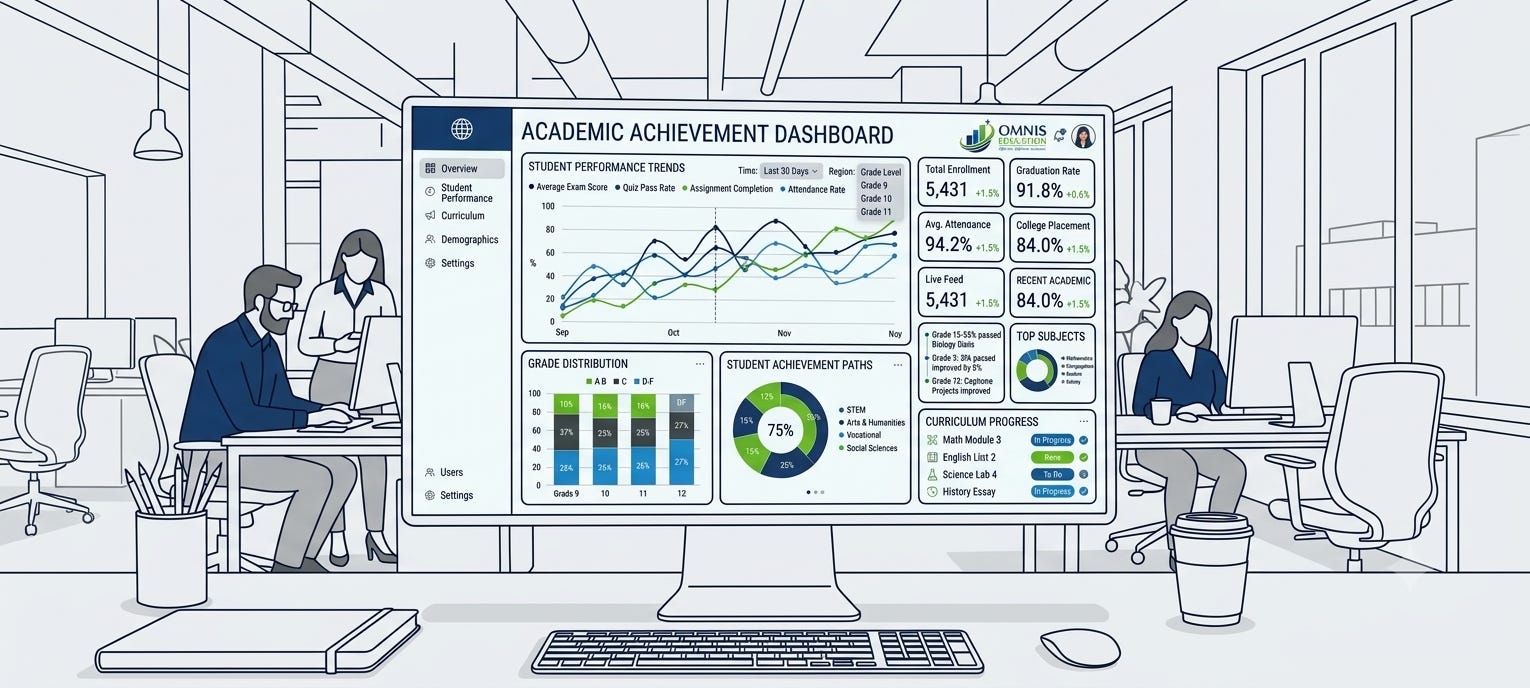
Once a central office team finally built a shared tracking dashboard with real input from the school staff who would use it, the initiative’s pace accelerated within a semester, and the gap between schools began to close.
Fixing that wasn’t a matter of buying software or hiring a data scientist. It required going back to the accountability office and asking a harder question than “Are the state reports accurate?” It required asking who the office actually served and being willing to hear that the answer, for years, had been the state, not our own schools. Changing that answer meant giving the office a second mission alongside the first one, building tools for schools instead of only reports about them, and staffing and funding that mission as if it mattered as much as the compliance work always had. We did that unevenly. Some offices absorbed the shift faster than others, and I don’t think we ever fully closed the gap between what schools needed and what central office provided in real time. But North Star got better the moment the office started answering to schools instead of only to the state, and that’s the test I’d ask any superintendent to apply to their own data office before assuming it’s already doing its job.
Dr. Sean Bulson is a practitioner-scholar, professor of educational leadership, and the 2024 Maryland Superintendent of the Year. He served as superintendent of Harford County Public Schools from 2018 to 2026 and Wilson County Schools from 2011 to 2016. Subscribe for weekly posts on educational leadership, equity, and district transformation.