

For three years running, I sat in budget meetings where we cut nearly everything but still added money to special education. Enrollment was down. Every other line was shrinking to match it. Special education kept growing because a new IEP is a legal obligation, not a discretionary choice, and the number of students receiving those IEPs was still increasing each year. It took me multiple years of watching that pattern until I understood what those additions were doing to everything else in the budget.
That pattern is not unique to my district. I pulled enrollment data from three states with very different politics, geography, and school funding models, and the same trend appears in each. In Maryland, general education enrollment fell by roughly 2,300 students between fiscal years 2021 and 2026 while special education enrollment rose by about 14,000, pushing the special education share of total enrollment from 12.53% to 14.16%. In Texas, over a longer window from fiscal 2019 to 2026, general education enrollment dropped roughly 35,000 students while special education enrollment grew by about 379,000, nearly doubling its share of the student body from 9.79% to 16.67%. Indiana, over the same 2019 to 2026 span, saw general education enrollment fall by about 27,000 students, while special education enrollment grew by 18,000, raising its share from 15.55% to 17.75%. The years do not line up perfectly across all three states, and the reporting behind each figure comes from different systems. However, the direction of every example makes the same point. Enrollment is going one way. Special education identification is going the other way.
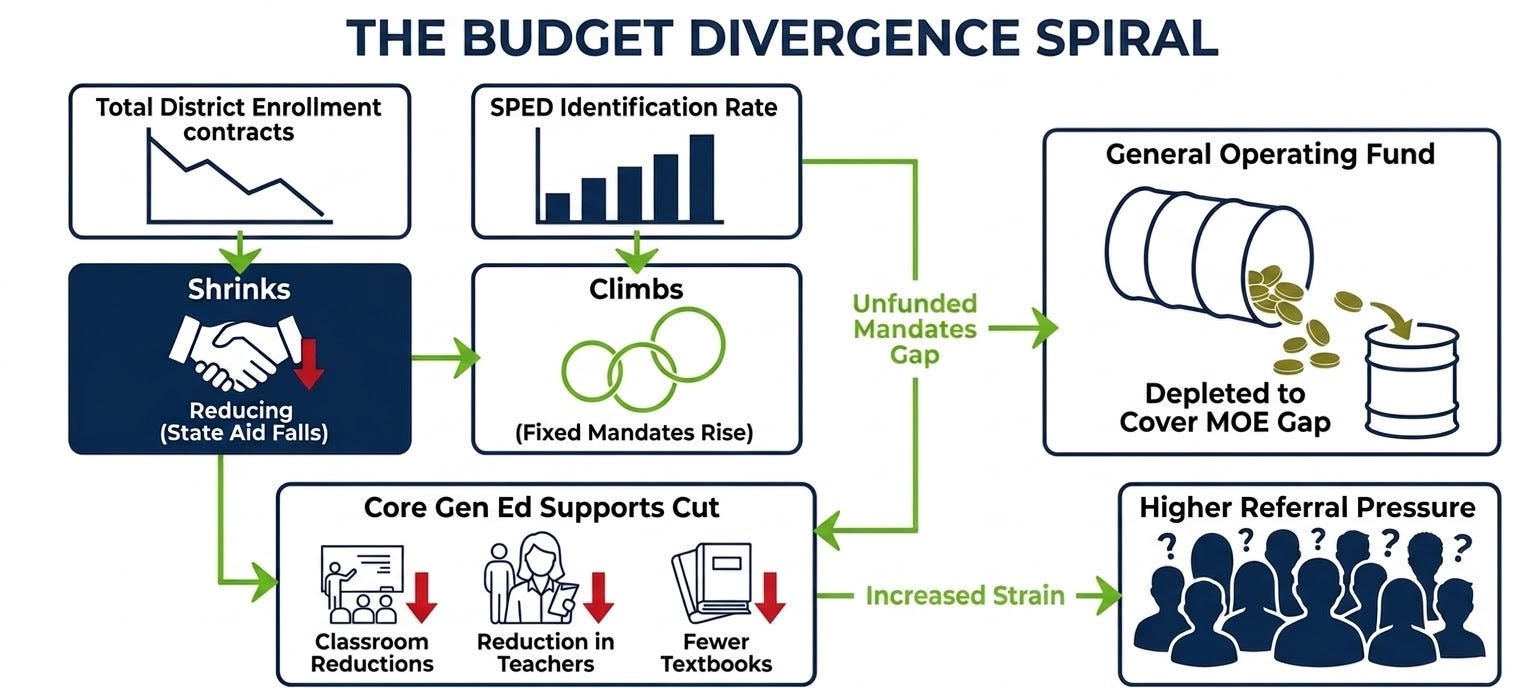
Across hundreds of public-school systems, the standard playbook for enrollment decline has stopped working. Fewer students used to mean fewer classrooms, adjusted staffing ratios, and a state aid formula that shrank in step with the operating budget. That logic still applies to general education, but total enrollment can decline while the number of students qualifying for services under the Individuals with Disabilities Education Act continues to climb. Overall state and federal aid shrinks while mandated special education services expand. The general fund absorbs the gap between the two.
Why You Cannot Cut Your Way Out
In a typical district budget, special education now accounts for twenty to twenty-five percent of total operating spending. When enrollment drops five to eight percent and state aid contracts with it, the administrative instinct is to trim every department proportionally. Special education resists that instinct for two reasons unrelated to willpower or management skills.
Federal maintenance-of-effort requirements attach real consequences to any year-over-year reduction in special education spending. A district that cuts that budget risks compliance sanctions and the loss of federal funding under Part B of IDEA. And an Individualized Education Program is not a budget line a superintendent can adjust. It is an enforceable civil right. When a student’s IEP requires specialized transportation, a dedicated aide, or an out-of-district placement, the district funds these services regardless of the state revenue that year.
So, the cuts land somewhere else. General education absorbs them. Class sizes grow, interventionists disappear, and the core instruction that might have caught a struggling student before a formal evaluation weakens along with everything else. Struggling students get referred for evaluation more often once that early intervention thins out; identification rates climb, and the district that started this cycle, trying to balance a budget, ends up further from balance than when it began.
What a District Can Do
None of this requires choosing between fiscal discipline and the students the mandate exists to serve. It requires four shifts, and a district can make real progress on all four without waiting for a state formula to change.
The first is reducing unit cost without touching service quality. Moving agency-dependent roles toward a hybrid delivery model and centralizing assistive technology procurement around a lending library that tries low-tech solutions first both cut spending without cutting a service a student receives.
The second is capturing revenue the district has already earned. Integrating IEP documentation with automated Medicaid billing can push capture rates toward 90%, funding services already being delivered rather than paying for anything new.
The third is matching staffing to where students actually are. A weighted caseload model that accounts for acuity, not just headcount, slows the turnover that drives up agency dependency in the first place and evens out service minutes that otherwise vary wildly by building.
The fourth is preventing the most expensive placements before they happen. A district that builds in-district capacity for the students it would otherwise send out, and pairs that with a dispute resolution process applied consistently and early, keeps both placement costs and legal spending from compounding year over year.
I did not see all four of these clearly at first, and I know none of them are easy to execute. Unfortunately, the current trajectory most districts are on is unsustainable. I watched costs and enrollment go up while the rest of the budget shrank. Since leaving the superintendency, this has been the problem that has captured my attention most. Making special education budgets more fiscally sustainable is important from a governance perspective, but it is absolutely essential from a student achievement perspective. That is why superintendents can’t delegate this work to others.
Dr. Sean Bulson is a practitioner-scholar, professor of educational leadership, and the 2024 Maryland Superintendent of the Year. He served as superintendent of Harford County Public Schools (2018-2026) and Wilson County Schools (2011-2016).